2027 is coming: how to read a price shock before it reads you
A Botswana sales newsletter warns of 2027 price increases. Econsult's data shows how a global shock becomes a shelf price — and why your own basket is the number that matters.
A newsletter landed in our inbox this week with a headline designed to make you check your bank balance: 2027 price increases — prepare for the shock.
It is worth reading. It is also worth reading carefully, because the distance between "prices may rise" and "here is what you should do on Saturday" is where most household budgets get lost.
We read it, checked the numbers behind it, and pulled the Botswana-specific analysis. Here is what actually holds up — and what it means for the number that matters: what you pay.
What the newsletter actually says
The piece (from LECHA Sales, an energy-and-finance commentary) makes a chain of claims that are, on the whole, well argued:
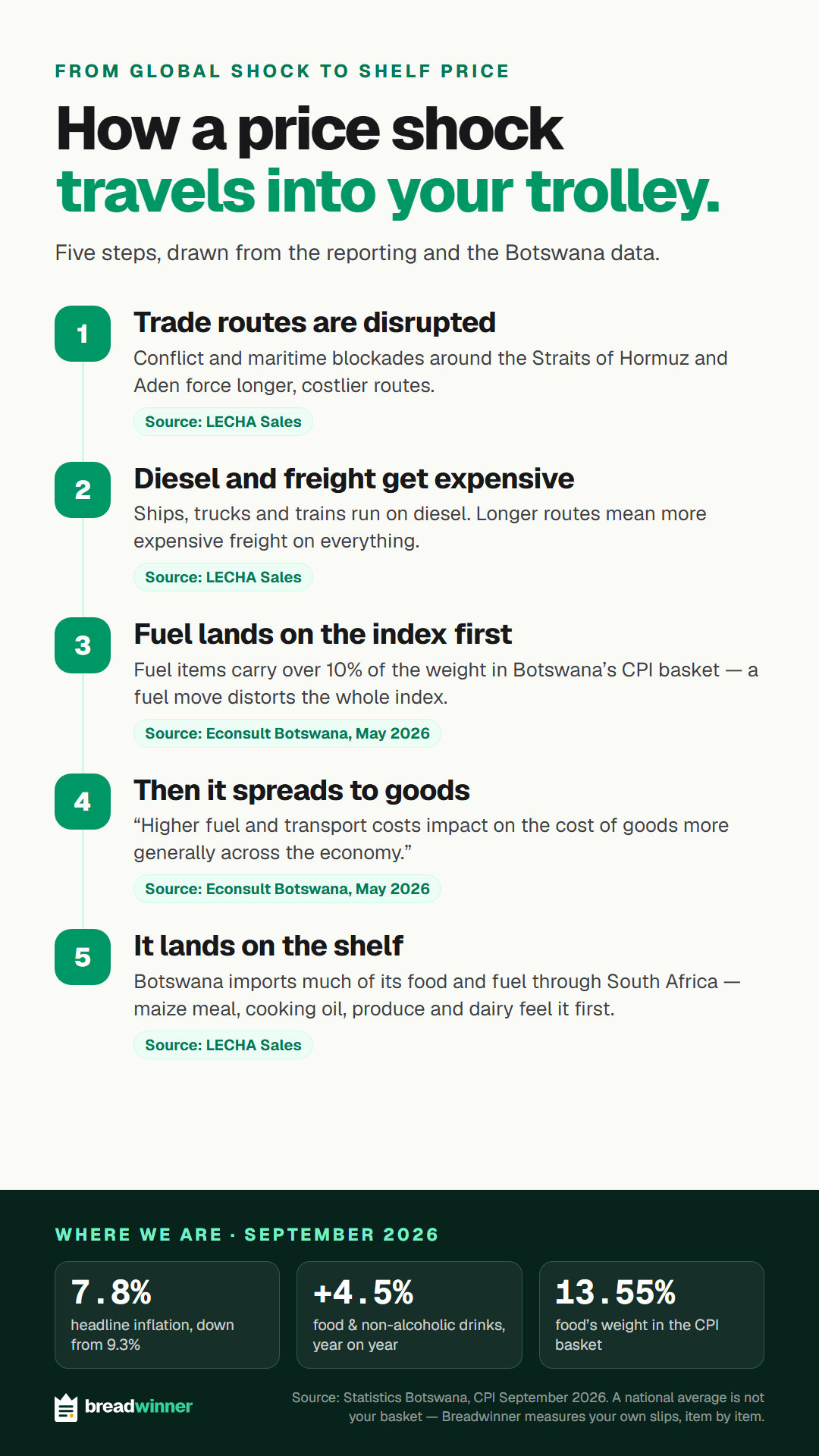
- The trigger is global. Ongoing geopolitical tension — the Russia-Ukraine war and maritime disruption around the Straits of Hormuz and Aden — is disrupting trade routes and supply chains.
- Diesel is the transmission belt. Ships, trucks and trains run on diesel; longer routes mean more expensive freight, which raises the cost of moving goods.
- Fertiliser is scarce, which constrains how much food farmers can grow.
- Energy costs are climbing globally, hitting every factory, farm and processing plant.
- Botswana feels it directly, because a significant share of food, fuel and manufactured goods is imported, primarily through South Africa. The piece flags maize meal and wheat products, cooking oil, fresh produce and dairy as the categories most exposed — and notes that fuel costs tend to feed through to combi and taxi fares.
- Its advice: review the budget, buy non-perishables in bulk before prices peak, grow basic vegetables, conserve energy.
That is a sensible list. But notice what it does not say: it doesn't tell you how to tell, in your own shop, on your own slip, whether the shock has already arrived in your basket.
What the Botswana data adds
Here is where local economic analysis earns its keep. Econsult Botswana — the Gaborone research house founded in 2005 by Dr Keith Jefferis, a former Deputy Governor of the Bank of Botswana — has been tracking exactly this transmission mechanism.
In May 2026, Econsult explained a striking CPI move: inflation jumped from 4.2% in March to 10.3% in April, driven almost entirely by a large increase in regulated domestic fuel prices in late March. Their point was structural, not incidental: fuel items carry over 10% of the weight in Botswana's CPI basket, so a fuel move lands on the index disproportionately — and then spreads.
"We expect further increases in inflation in the coming months as higher fuel and transport costs impact on the cost of goods more generally across the economy."
That single sentence is the whole story of a supply shock in a small, import-dependent economy. Fuel is not just something you put in a car. It is embedded in the price of every item that travelled to reach the shelf.
Econsult's May forecast was that inflation would peak between 12% and 13%. What actually happened was a rise, then an easing: Econsult reported inflation steady at 10.7% in June 2026, and by September Statistics Botswana put headline inflation at 7.8%, down from 9.3% in August. Forecasts move with the data — which is rather the point: treat any single number as a direction, not a verdict.
But read the detail beneath that headline, because it is more useful than the headline:
- Food and non-alcoholic beverages rose 4.5% year on year.
- Food prices fell 0.6% month on month — vegetables led the decline at −3.0%.
- Food carries 13.55% of the weight in the national CPI basket.
So: the annual figure still shows food getting more expensive, while the monthly figure shows it easing. Both are true. A household feels the monthly movement at the till and the annual movement in its budget.
That is the pattern to expect into 2027 — not a single cliff edge, but a series of shelf-level adjustments, category by category, some up and some down.
Why the average is not your number
Here is the part that generic advice tends to skip.
The CPI is an average across all households and all goods. Your basket has different weights. If you are feeding a family, food is a far larger share of your spending than the 13.55% it carries nationally — often a third or more. A 4.5% food rise therefore hits you harder than a 4.5% average suggests.
Your basket also has different items. The national index contains hundreds. Yours contains maybe thirty. If the ten things you buy most moved differently from the average, your personal inflation rate moved differently too.
And your basket has different shops. The same item carries different prices in different chains — and even in different stores within one chain.
Which means: a forecast of 2027 price increases is a forecast about the average. It tells you the weather. It does not tell you whether to take an umbrella on your street.
Where the standard advice breaks
Take the newsletter's most practical recommendation: buy in bulk before prices peak.
It is good advice — conditionally. Bulk only saves money when two things hold:
- The unit price is genuinely lower than the smaller pack. Sometimes it isn't. We have seen 2 kg packs priced higher per kilo than two 1 kg packs.
- The product survives to the last use. A 10 kg bag that spoils is more expensive than three 3 kg bags you finish.
This is not a quibble. It is the difference between preparing for a price shock and pre-buying the wrong things at the wrong unit price. Stockpiling is a bet on two variables — price direction and spoilage — and most households only think about the first.
The same applies to "review your budget". A budget you cannot see is a budget you cannot fix. If you don't know your unit price for cooking oil three months ago, "review" means guess.
Where Breadwinner fits — honestly
Breadwinner does not forecast inflation, and it will not tell you what 2027 will bring. Nobody can do that reliably.
What it does is narrower and more useful: it measures your basket at the level where prices actually land — the line item.
- Scan a till slip; every line is read with its unit cost — per kg, per litre — not just the shelf price.
- Because unit costs are stored, pack-size changes and "deals" become visible over time rather than invisible.
- Your own history shows what you paid for the items you actually buy, so a category move shows up in your numbers, not someone else's average.
- Free accounts keep 7 days of history; Premium keeps 90 days — enough to see a quarter-on-quarter trend rather than a single month of noise.
- Prices shared for community comparison are aggregated and permission-based, so no individual's shopping is identifiable.
That is the case for using it now, before 2027 rather than during it: a price shock is much easier to absorb when you already know your baseline. Households that discover their unit prices during a spike are learning in the most expensive classroom available.
A four-step plan for the next quarter
If you take the newsletter's warning seriously, do this instead of panic-buying:
- Build a baseline now. Keep four weeks of slips. Pick 10–15 items you buy most months and record the unit price. That is your starting line.
- Apply the bulk test. For each staple, compare the unit price of the big pack against the small one. Buy bulk only where the unit price is lower and you will use it before it spoils.
- Rank by spend, not by percentage. Your top three lines by monthly spend are where a price rise hurts most. A 12% rise on cooking oil matters; a 12% rise on tea does not.
- Pick three items to watch. Oil, maize meal, bread — whatever dominates your basket. Track their unit price monthly. Three months makes a trend; one month is weather.
You cannot influence the Straits of Aden. You can know what you paid per kilo last month, this month, and next — and that is the only lever a household actually holds.
Start with one slip. It is free, 10 slips a month, no card: app.breadwinner.deals
Sources
- LECHA Sales, 2027 price increases: prepare for the shock — global supply-chain disruption, Botswana import exposure, category risk and household preparation advice. lecha-sales.beehiiv.com
- Econsult Botswana, Inflation jumps to 10.3% due to higher fuel prices (May 2026) — April inflation 4.2% → 10.3%; fuel items over 10% of the CPI basket; expected peak of 12–13%. econsult.co.bw
- Econsult Botswana, Slight uptick in inflation, sharper price rises ahead (July 2025) — exchange-rate change and the expectation of 9–10% inflation within 12 months. econsult.co.bw
- Statistics Botswana, Consumer Price Index — September 2026 (published 15 October 2026) — headline 7.8% (from 9.3%); food and non-alcoholic beverages +4.5% y/y and −0.6% m/m; food weight 13.55%; vegetables −3.0% m/m. PDF
All figures checked 5 November 2026 against the sources above. Forecasts are the forecasters' own, and can be revised — we quote them as forecasts, not outcomes.
Check your own slips
Breadwinner reads any receipt and shows what you actually pay, item by item. Free to start: 10 slips a month, no card required.
Keep reading
Reading inflation in your own trolley
Botswana's headline inflation was 7.8% in September 2026. Your groceries don't read headlines — this is how to measure what prices are actually doing to your own basket.
Feeding a family of five: a worked grocery budget
A five-person household is a small food operation. Here is a worked monthly basket, where budgets leak, and the swaps that usually free up money.
Seasonal eating: what's cheap when
Vegetable prices move with the season. Buying with that rhythm is not romantic — it is the simplest unit-price win in the shop.
Press and editorial enquiries: hello@breadwinner.deals